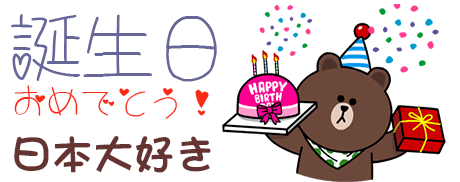
Happy Birthday Nihon Daisuki!

nihondaisukibirthday

ヽ(*´∀`)ノオメデト─ッ♪

2014年9月13日:Today is our first anniversary! I didn’t.. quite.. have this in mind though because I’ve been away for long. ^^; Coincidentally happened to notice the timestamp yesterday of the very first post, and realized it’s been one year already since I started this! And on this anniversary, I promise to regularly update this blog as often as I can, hopefully twice a week! So if you’re a Japanese learner, or just like reading what I share, please do subscribe to us by clicking the second button on the top menu. ^^ Doumo arigatou!

Ja.. On this note, let’s kanji/kotoba talk over wishing someone for their birthday or anniversary, in Japanese!

誕たん生じょう日び (tanjoubi)

Meaning: Birthday
誕生 (birth) + 日 (day)

Note that the pronunciation of 日 changes from ひ to び in this compound kanji.

おめでとう!(omedetou)

Meaning: Congratulations!
You can use this to wish someone for any kind of achievement or occasion.

To wish someone on their birthday, you would say:

誕生日おめでとう! (tanjoubi omedetou!)

For formal usage, you can wish: お誕生日おめでとうございます!The おー prefix is optional, to make it more formal.

In case you forgot their birthday, and need to send a belated wish.. ^_^;

遅おくればせ(ながら)、誕生日おめでとう!

To ask someone when their birthday is:

誕生日はいつですか?

Trivia: The “いつ” here (meaning “when”) shares the same Kanji with “なんじ” (meaning “what time”).

何時

However, we write it in Hiragana for いつ and in Kanji for 何なん時じ.

And of course, if someone wishes you, you reply “ありがとうございます!” which is what I say to you now for your wishes. ^^;

Kanji that resemble Katakana

There are times where you’ll come across Katakana-like characters that aren’t.. really.. Katakana. Like there wasn’t enough confusion already with Kanji readings and compounds, here’s another challenge.

Below are a few Kanji that look like Katakana, with very minute variations that you might probably not notice, and simply have to depend on the context to distinguish. Much like how the number “1”, letter “l” (lowercase el) and letter “I” (uppercase aai) at times look alike depending on the font, but it doesn’t confuse a native speaker as much for a learner.

KatakanaKanjiKanji readingKanji meaning
エ工koucraft, work
カ力ryoku, riki, chikarapower, force
ニ二nitwo
ハ八hachieight
ロ口kou, kuchimouth
オ才saiability, talent, aptitude
タ夕yuuevening

Share your experiences with such if any.

Kanji: 大

Big, large, great

大 Kanji

This is my one of my favorite Kanji, and gets me somewhat high every time I notice it somewhere. Because of my presently limited knowledge of Kanji, I can only make out a handful of them from written text, so certainly when one of the most simple of Kanji like 大 appear, it makes me want to instantly scream – TAI/DAI! 

大 means large or great (also university). When attached to another Kanji (either before or after), usually acts like an adjective.

For example:

大だい学がく

Large + Learning/School = High school or University

大おお水みず

Large + Water = Flood

大おお男おとこ

Large + Man = Giant / Great man

大おお雨あめ

Large + Rain = Heavy rain

Though this is not always the case for every usage, as compound Kanji often don’t make sense. It is also used with Okurigana such as 大して (taishite) or 大きく (ōkiku). As you’ve noticed already, and with every Kanji having several readings, it is read as:

On-yomi: だい (dai), たい (tai), た (ta)
Kun-yomi: おお (ō), おおきい (大きい, ōkii), おおいに (大いに, ōini)

So you cannot just go reading it DAI everywhere just because it sounds better, as I would have liked, lol. You’ll have to learn as many commonly used words out there that contain 大 to know the readings, if you end up getting obsessed with the character.

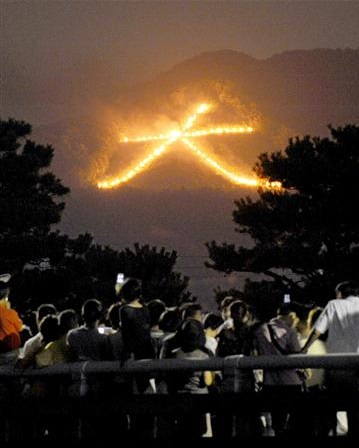
Speaking of obsession, even the Japanese celebrate a festival Daimonji (大文字), where large (pun intended) bonfires are lit, one forming the shape of 大.

大文字送り火

大文字送り火

Note that 大文もん字じ (daimonji) also translates to “the character 大 dai”, wherein 文字 (monji) is the word for “character”.

Meal Times

飯

ご飯

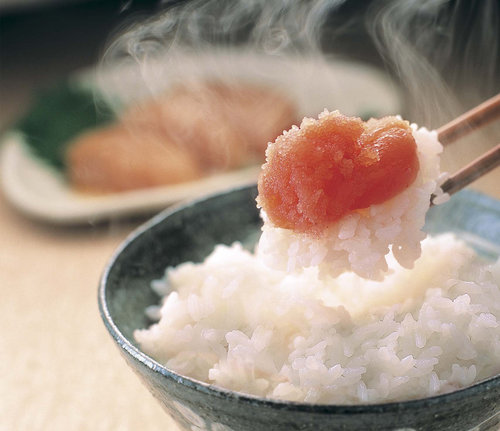
ご飯はん (Gohan) is the word for cooked rice (米 for uncooked rice). However, since it is an essential part of Japanese cuisine, it is also used to mean a meal. The ご~ is honorific and 飯 is rice, however 飯 used informally is read 飯めし (Meshi) and not just “han”, without the  ご prefix.

朝あさご飯はん ・ 朝あさ飯めし
Breakfast / Asagohan / Asameshi

朝 (Asa) means morning. So morning + meal = breakfast.

昼ひるご飯はん ・昼ひる飯めし
Lunch / Hirugohan / Hirumeshi

昼 (Hiru) means noon.

晩ばんご飯はん ・晩ばん飯めし
Dinner / Bangohan / Banmeshi

晩 (Ban) means evening/night.

Side note: The “go” in gohan originally has the Kanji 御, however we can use the Hiragana ご due to avoid complexity.

Read more on gohan vs. meshi usage on StackExchange.

Read about honorific usage in the Japanese language over here.